Senior Manager, Product Design

Wayfinder.
Trust-earner.
Culture-builder.

15+ years turning fragmented, stuck design teams into high performers — at Walmart, Alaska Airlines, American Airlines, and AT&T. I change what the team believes is possible. I find the path when it isn't there. Every team I join becomes the turning point in its story.

Scroll to explore

Who I am

Design leadership is a people problem wearing a product hat.

FTE Most Innovative Airline Initiative — Smart Ramp, Alaska Airlines, 2025
Webby Award — Best Mobile User Interface — Walmart Website & App, 2022

I'm Tre — a senior design leader with deep experience in consumer identity systems, large-scale operational platforms, and the hardest design challenge of all: building the culture that makes great work possible.

My work sits at the intersection of strategy and craft. I don't just manage teams — I shape the conditions that let designers do the best work of their careers. That means asking "should we?" before "can we," going to the tarmac when the office has the wrong answer, and advocating for a designer with the VP before they've done a single thing to earn it.

When the path isn't clear, I find it. When the team is stuck, I unstick it. When the product needs to earn trust from real people in real, high-stakes moments — I know how to design for that.

Strategic thinker
Connects design decisions to business outcomes before anyone asks.
People-first coach
Invested in every person's growth — not just the output they ship.
Systems builder
Builds practices and processes that outlast any single project.
Culture shaper
Creates environments where curiosity and accountability coexist.
Calm in chaos
The person you want in the room when stakes are high and answers aren't clear.

Work

Three chapters. Each one answers a different question a hiring manager might have about whether I can lead.

01 Walmart Consumer Identity
Friction was the right answer
Phone verification cut account creation 40% — and net GMV per account went up 56%. That's not a contradiction. That's the product.
Walmart phone verification flow

01 — The problem

$180M in fraud.
Three orgs.
No shared architecture.

100M+ users. $180M+ in annual fraud losses. Only 11M of a 52M verified-phone goal reached. Bots were farming account creation to steal Walmart+ trials; 15% of accounts had undeliverable email addresses. Three product orgs were building identity in parallel silos with no shared architecture.

Product's position: requiring phone verification at sign-up adds friction, reduces accounts, reduces GMV. The debate stalled because neither side had proof — just instinct vs. instinct.

Original Walmart sign-in flow before redesign

02 — My role

Design the
controlled test.

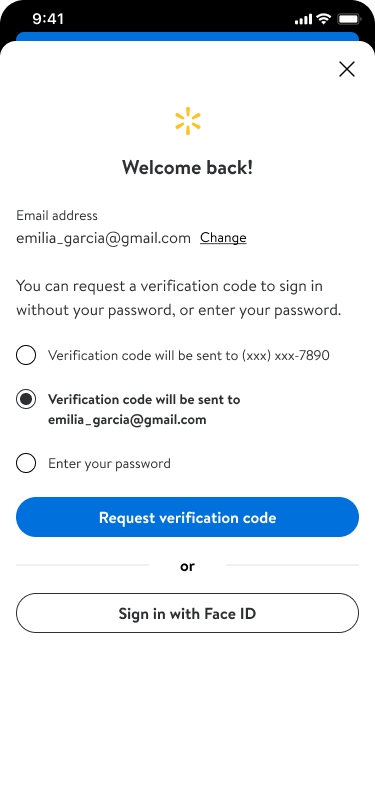
I partnered with product to design a controlled test instead of arguing the point. Mandatory OTP phone verification at account creation vs. a no-verification control — rolled to 50% of web traffic for eight days, then 100%.

The question wasn't "does friction hurt conversion?" We knew it would. The question was: are the accounts we're losing worth keeping?

I also co-designed the FIDO passkey flow — friction at the gate, smoothness after. Once identity is verified, authentication gets faster, not harder.

Designed phone OTP verification screen

03 — Outcome

Verified phones:
11M → 52M+

+56%
Net GMV per account
$75 → $117 / year
+136%
Contribution profit / account
$0.58 → $1.37
$8.4M
Annualized contribution
profit increase
−64%
Account takeover
bad-count rate
Walmart mandatory phone verification happy path — final design

What I'd do differently

Set the metric
before launch.

A 40% drop in account creation looks catastrophic on a dashboard. It took stakeholder work after the readout to reframe the result. Next time I'd align on the success metric — fewer, higher-quality accounts — before launch, not after. The data was right. The setup for the data wasn't.

02 Alaska Airlines Operational Tools
Deployment isn't adoption
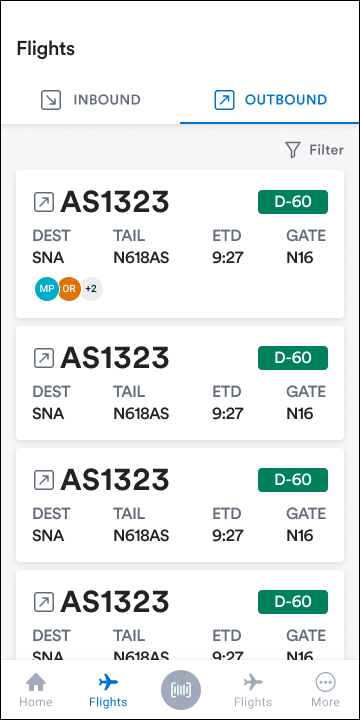
We replaced 18-year-old handheld scanners with a mobile app and rolled out to 17+ stations in one quarter. Then we found out those are two different problems — and built the instrumentation to close the gap.
Alaska · RAMP

The problem

We measured
if we shipped.
Not if it worked.

RAMP processes 18M+ baggage scans annually across Alaska and Hawaiian Airlines. The platform replacing it — RSA Mobile, 18-year-old hardware that took weeks or months to update — had no telemetry. No way to know if agents were using a feature, struggling with it, or working around it entirely.

We shipped RAMP Upload and deployed to 17+ stations by November 2025. Then we looked at the data: stations like Anchorage and San Diego had devices deployed, the app installed, and adoption lagging. Those are two different problems, and we didn't have the instrumentation to answer the second one.

Alaska · RAMP Upload

My action

Instrumentation
as a launch
requirement.

Two moves in parallel. First, I made adoption instrumentation non-negotiable — not a post-launch add-on, but part of what "shipped" means. Pendo gave us daily active users, station-level usage patterns, and where agents were dropping off. Once we could see the gaps, we used in-app guides to deliver workflow guidance in context at the worst-adoption stations.

Second, I built a split-flag rollout discipline: Boise first, Denver next, then system-wide. The legacy platform required weeks to push a single fix. RAMP Upload gave us same-day hotfix capability. I built the release process to use it responsibly.

Anchorage wasn't failing because agents disliked the app. They weren't getting clear guidance on the new workflow at the moment they needed it. In-app guides fixed that without requiring retraining or manager intervention.
Pendo · In-app guidance

Impact — RSA Mobile is retired. RAMP Upload runs 58 stations.

From deployed
to adopted.

+131%
Informational scanning
across RAMP system
+400%
Bags scanned
at Anchorage
+75%
Agent adoption at
challenging stations
−28min
Weekly flight delay
minutes (253 → 182)
58 stations · 18M+ scans/year

What I'd do differently

Instrumentation
first. Launch
second.

We added adoption instrumentation after the rollout was already in motion. That's the wrong order. Pendo should have been part of the launch definition from day one — what "live at a station" means should have included active user tracking, not as a follow-on. And when Anchorage went from near-zero to 400% improvement, those agents deserved to hear: here's what you did, here's what it changed. We measured the outcome and moved on. That's a missed chance to reinforce the behavior and build trust for the next change we ask them to make.

03 Alaska Airlines People Leadership
The lid is off
A designer transferred to my team with three flags on his record: not proactive, struggles with ambiguity, risk-averse. Five months later he was presenting solo in the executive suite — and the managing director was asking follow-up questions.
The solo presentation

What I inherited

Not proactive.
Struggles with ambiguity.
Risk-averse.

When he transferred to my cargo team in November, the read from his previous manager was clear: not proactive, struggles with ambiguity, risk-averse. His PM said he'd surface an opportunity and he'd sit on it. When requirements weren't defined, he'd freeze.

I listened. I wrote it down. And then I went to see what I actually thought.

What I found was more specific: he'd come from a team dynamic that had gradually worn down his confidence. He had the skills. He was reading the room to decide if using them was worth it. Before I could ask him to take more risk, he needed evidence this environment responded differently.

The solo presentation

The sequence that mattered

Make a deposit
before you ask
for behavior.

Six weeks in, before he'd done anything to earn my advocacy, I was in a 1:1 with our VP calling out what product was doing wrong. They'd put him on ULD domain work before he'd been onboarded into the domain and were wondering why he wasn't driving. I raised it directly. He found out about that conversation later.

Before I asked for different behavior, I made a deposit. The coaching doesn't start with the behavior you're trying to change. It starts with the environment.

From there: frequent predictable 1:1s (not check-ins — access). One concrete target at a time. Supervised field visits to SeaTac cargo ops, then independent ones. When he was supposed to own a room, I stopped contributing and sent coaching notes after — because once I take the floor back, there's no clean way to return it in the same meeting.

The solo presentation

Where he landed — March 31, executive review

Solo. Executive room.
5 months.

5 mo.
November to
executive presentation
Solo
Presented to MD of
product & design
3
Designers he now
coordinates as IROPS lead

He presented to Alaska's managing director of product and design — field observations, process maps, design decisions, error handling, agent testing, Q2 roadmap. The MD asked precise process-level questions throughout. His overall read: "This is great." Six months earlier, this was a designer who was nervous presenting to his own PM.

The solo presentation

What I'd do differently

Name the gap
sooner.

The observation period ran two months before I named a concrete goal — and that had a cost. Product was bypassing him, the passivity was calcifying, and I was still reading the situation. Three or four weeks of signal is enough to name a gap and give someone one thing to practice. That timeline cost him. I also didn't pull his PM into the coaching loop early enough. She was seeing the same patterns, and a short conversation in November would have given him consistent signals from two directions at once.


Experience

15+ years across


Voices

Leadership in practice

The work only matters if people can move with it. A few notes from partners who have seen the method up close.

Erin Sian Williams

Sr Director, UX Design — Walmart (direct manager)

Tre is a natural leader and especially shines in helping other designers gain confidence in their role; he helps teammates get comfortable sharing bolder ideas, sharpen their critical skills and push their work to new places.

Diego Brunot

Manager — American Airlines (direct manager)

He has an innate ability to make people feel comfortable and supported, fostering a collaborative and positive work environment. I have seen him reach out to peers during vulnerable moments, providing the mentorship and support needed to help them succeed.

Demetrios Roumbos

Product Designer — Walmart (same team)

What sets Tre apart is his remarkable attention to detail paired with strategic vision. He has an uncanny ability to spot subtle inconsistencies while never losing sight of the broader project and problem at hand.


Let's
talk.

If you're building a design team that needs to find its footing — or one that's ready to do the best work of its life — I'd love to be in that conversation.

Let's connect Email me